Three years in the making, Dave Matthews Band's Away From the World is produced by Steve Lillywhite, who produced the band's first three studio albums. The lineup of the band has undergone changes but has remained strong. Tim Reynolds contributes to the album on electric guitar. Replacing saxophonist LeRoi Moore, who died in 2008, are trumpeter Rashawn Ross and saxophonist Jeff Coffin. The album is musically solid, balancing between rocking and acoustic tracks and creating a more favorable impression overall than their previous album.
The album's lyrics include themes of love, being yourself, and making a difference in the world, and can be on the cheesy side. I always think of Dave Matthews Band as being more about the music than the words, with the occasional song that really gets it right lyrically, so this is par for the course. For example, the lyrics to "Gaucho" mostly consist of: "Gotta do much more than believe/If we wanna see the world change." This seems to be an overplayed sentiment in songs.
"Sweet" is my favorite song on the album. Dave plays a ukelele and sings poignantly high notes. "The Riff" follows, with some good lyrics, including, "Why waste time staring at the TV set/Like I got dreams to kill and people to forget." The song closes with a blistering guitar solo by Tim Reynolds. Another standout is "Drunken Soldier," a satisfying album closer at almost ten minutes long. Dave sings, "Fill up your head and fill up your heart and take your shot/Don't waste time trying to be something you're not."
Rating: 3.5 out of 5 stars
Tuesday, September 25, 2012
Sunday, August 19, 2012
Review of Close to Shore
I read Close to Shore: The Terrifying Shark Attacks of 1916, by Michael Capuzzo to gear up for the twenty-fifth anniversary of Shark Week that aired on the Discovery Channel last week. An approximately eight-foot-long juvenile Great White shark, the author says, terrorized the New Jersey and Long Island coastal areas during the summer of 1916, killing four people and wounding one. Incredibly, it even made its way--and survived--from the ocean to a creek. This summer of localized attacks by an apparently lone shark inspired Peter Benchley to write the book Jaws--which Stephen Spielberg then made into the summer blockbuster movie of 1975.Before 1916, the prevailing opinion in the United States was that sharks would not attack a living person in the country's temperate waters without provocation. After the attacks, leading authorities admitted that their perceptions about sharks had changed.
The book's strength actually lies largely in describing the historical setting and certain cultural changes that were occurring during this period. Ocean swimming was just becoming popular and New Jersey resorts were sought-after by the leisure class. Capuzzo also does a good job of noting some interesting facts about sharks and the history of our perception and study of these animals. The author takes his time with all of this context before getting into the attacks.
There are a couple of loose ends the author does not tie up. Was the shark that killed those people during the summer of 1916 ever captured? The author leaves this question unanswered, although it seems likely that the shark was caught.
Capuzzo seems to subscribe to the theory of a rogue shark--one that strays from its usual food source and hunts humans because of illness, injury, or some other factor that makes it difficult for it to get its usual prey. Yet at the end of the book he talks about how the theory of rogue sharks has fallen out of favor in recent years. Throughout the book, however, he never offers as a possibility that multiple sharks could have been involved. Why does he subscribe to the rogue shark theory in this case? His argument would have been more convincing if he had offered definitive evidence to support his point of view.
Despite these points left up in the air, the book offers a lot to make it a good read: a thrilling story reconstructed from true events, some colorful characters, fascinating information about sharks, and thought-provoking reflections about changes in American culture.
Sunday, July 15, 2012
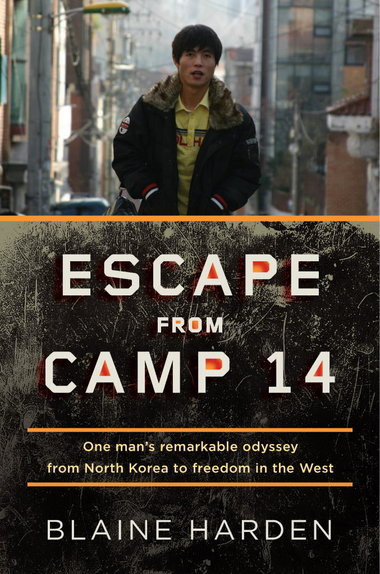
Review of Escape from Camp 14
Escape from Camp 14: One Man's Remarkable Odyssey from North Korea to Freedom in the West, by Blaine Harden tells the story of Shin Dong-Hyuk's harrowing life within a North Korean prison. He is the only person known to have been born and raised in a North Korean prison camp to have escaped. He was born in Camp 14 in 1982 and made his way to South Korea in 2006. He moved to the U.S. in 2009 and lives in Washington, D.C. and Seoul. Between 150,000 and 200,000 North Koreans work as slaves in its political prison camps.
Shin grew up in a prison camp because of the crime of a relative who fled to South Korea after the Korean War. Shin's life inside the camp included seeing his mother as a competitor for food, being groomed by guards to snitch on anyone including and especially his family, and witnessing the execution of his mother and brother.
This is not only the story of Shin's experience in and escape from Camp 14 but is also a story of aftershocks--where does a physically and emotionally scarred individual who has endured real-life dystopian horrors go from there? He explains, "I am evolving from being an animal, but it is going very, very slowly. Sometime I try to cry and laugh like other people, just to see if it feels like anything. Yet tears don't come. Laughter doesn't come."
For a glimpse into the situation in North Korea from those living it, I also recommend Nothing to Envy: Ordinary Lives in North Korea, by Barbara Demick. I haven't yet read but am interested in reading The Aquariums of Pyongyang: Ten Years in the North Korean Gulag, by Kang Chol-Hwan and Pierre Riguelot. Escape from Camp 14 offers an often hard to take but important inside view of the country's human rights catastrophe.
Wednesday, July 4, 2012
Fiona Apple's amazing new album
The Idler Wheel is Wiser than the Driver of the Screw and Whipping Cords Will Serve You More Than Ropes Will Ever Do is Fiona Apple's fourth album and first in seven years. It is a collaboration between Fiona and percussionist Charley Drayton; they coproduced it and played most of the instruments. This is a raw and pared down album that is certainly a departure from her preceding album Extraordinary Machine. It seems to have the most in common with her sophomore effort When the Pawn. The instrumentation is largely piano and percussion.
There are some interesting sounds in some of the songs. She explains about the song "Jonathan": "On the first night of recording with Charley, we walked by this bottle-making factory. The door was open and you could hear a machine running. We both had our recorders with us and we agreed that the sound would be good for the song." On "Anything We Want," she achieved a sound effect "with a pair of scissors, a tin full of burnt-cedar sashays, and a plastic cup. I was hitting everything with scissors and the cedar was flying all over the place." The song "Werewolf" includes a screaming sound that she was inspired to include after hearing a battle scene in a movie; she worked to find a duplication of it and finally found it in screams from a group of children at a school across from her house: "They were jumping with balloons between their legs, trying to make them pop. In the actual song, we had to take out all the balloon pops because they sounded like gunshots. But it was so perfect."
There is not a weak song on the album--all are strong musically and lyrically. In "Every Single Night," she sings, "Every single night's a fight/With my brain" and then later, "I just want to feel everything." And from "Werewolf": "We can still support each other/All we have to do's avoid each other/Nothing wrong when a song ends in a minor key." "Hot Knife" is the closing track, blending her and her sister's voices (they stood at the same microphone): "If I'm butter then he's a hot knife/He makes my life a CinemaScope screen showing a dancing bird of paradise."
My choral director in high school said that if an audience member described a performance as "ambitious," that meant that there was a high standard that was reached for and inevitably (and embarrassingly) not achieved. This is one album that can be called ambitious and actually live up to it.
Rating: 5 out of 5 stars
Monday, June 25, 2012
Review of Please Look After Mom
Please Look After Mom, by Kyung-Sook Shin (translated from the Korean by Chi-Young Kim) is an international bestseller and winner of the Man Asian Literary Prize. It is a moving novel told from the points of view of a daughter, son, father, and mother. The mother, sixty-nine-year-old So-Nyo, goes missing from a Seoul train station on her way to visit her children and her family launches a search to find her. Her children reminisce about growing up poor in the countryside and wrestle with guilt for not taking better care of her, their father feels sorry for neglecting her, and secrets are revealed.The author explains her choice to tell the story through four narrators: "I wanted to show a 'Mom' who was a complex and profound human being. As it was impossible to do this in a single person's voice, I needed multiple narrators. In the novel, the voices of the daughter, son, and father are narrated in the second person, 'you' and the third person, 'her.' It's only the mother who uses the first person. I had in mind the fact that, when a woman becomes a mother, she no longer gets to speak or sometimes even think in terms of that 'I.' Of the four different voices in the book, the mother's is perhaps the most vivid and powerful. When I was writing it, it felt as though my mother's hand had held--even gripped--my authorial hand, so that she could tell her own story." The chapter in which the reader gets to finally hear from the mother herself, written in the first person, is indeed the most affecting.
Shin hopes readers take away from the book the realization of "the plain truth that your mother was not born that way, that she too had to become a mother. Taking the time to think about your mother might also mean taking the time to think about yourself."
The book sheds light on both bonds among family members and life in contemporary South Korea. The shift from countryside to city life that So-Nyo's children take in relative stride is a different world to her and seems to add to the confusion she experiences as a result of her health problems. The family members deal with her disappearance in their own ways. Shin uncovers the complexity of individuals and of their familial relationships.
Tuesday, May 29, 2012
Review: Sara Bareilles, Once Upon Another Time EP
Two years after the release of her third and strongest full-length album, Kaleidoscope Heart, Sara Bareilles has come out with five-song EP Once Upon Another Time. It was produced by her friend Ben Folds. The first thing I noticed was that she has been working on her vocals, most evident on the first two tracks: more of a belting-it-out, R&B style. She certainly has the vocal capacity to pull it off, but that's a direction I did not anticipate.
Of making an EP as her next move, Sara explains to American Songwriter, "I knew I wanted to take some time off between my records and I wanted my fans to have some new music to tide them over. An EP is especially great because there's less pressure than with a record, so it's a good place to explore and play creatively without feeling like it will define my next career move." She goes on to say that "I wouldn't say this EP has a very concrete thread running through it. It's really about picking a collection of songs that I loved."
The title track, which is the opener, is largely a cappella. Sara notes that it "is really about loss of your childhood and letting go of your past, and that's a part of my life right now, a journey I feel like I'm on. It felt befitting to name the album that." "Stay" also showcases her vocals.
"Lie to Me" is a lively track, both in in its instrumentation (including strings) and lyrics: "Run your mouth/I bet I can catch it/You sound just like a Judas." Sara says of the song, "I actually write kind of mean lyrics, but usually wrapped up in a sunny song. For awhile I was having fun with that juxtaposition, but 'Lie to Me' is a bit more direct. It sounds like what it means. It's experimentation, finding new ways to express what I was trying to say."
"Sweet As Whole" unleashes her cheeky, foul-mouthed side. It recalls Cee Lo Green's "F*** You," which Sara loves and sings on tour: "I wish I wrote that song. I just think it's so ballsy, and brash, and I absolutely love it. It's awesome."
"Bright Lights and Cityscapes" is a ballad that is right on par with her best ones such as "City" and "Gravity." She describes it as "a very emotional performance. When I listen back to that vocal take, I don't hear my best singing and I get self-conscious about that. But Ben was adamant about getting a take that had a lot of emotion, and he was right: I was sitting in the piano room crying while singing, and he's the one who made me keep that on the record." That was a good move, because this is the Sara that resonates most with me and likely many others as well.
Rating: 3 out of 5 stars
Nuggets from the CLA conference
I attended the Connecticut Library Association conference for the first time on May 7th and 8th. It was held in Groton. In the past I've been to conferences for the New Hampshire and Massachusetts Library Associations. Nuggets:
With the right leadership and creativity, your program attendance can increase substantially, even in the face of cut funding.
Holding programs in a series is a good way to generate excitement.
Incorporate programs that bring in a harder-to-reach demographic: gardening and fishing programs can draw middle-aged men, and a program on how to win at blackjack can reach a younger male demographic.
Evaluation and assessment are buzzwords relating to both programming (things that may have worked in the past may not be working anymore) and interlibrary loan (how much is happening in this area?).
The Rethinking Resource Sharing Initiative is independent of the American Library Association's RUSA-STARS, the interlibrary loan subgroup. The Initiative has developed a useful checklist of best practices in interlibrary loan.
Everyday leadership means putting yourself in challenging situations; gaining fellowship (one's title is not enough); and is a conscious action. It also connotes conducting daily interactions with consistency and integrity.
Start asking questions like the head of an organization. Be a generalist; know it all.
Subscribe to:
Posts (Atom)