Tuesday, November 2, 2010

Devil in the White City movie in the works!

Leonardo DiCaprio and partners have acquired the screen rights to one of my favorite books, Erik Larson's Devil in the White City. DiCaprio will play serial killer H.H. Holmes, who murdered between 27 and 200 people during the time of the 1893 World's Fair in Chicago.

I am interested in seeing a film adaptation, but have a hard time believing I could like it as much as I like the book. The book is such an intriguing blend of true crime and architectural history. Larson juxtaposes (mostly in alternating chapters) the construction of the World's Fair, a magical success despite many obstacles, with Holmes' sinister construction of the World's Fair Hotel, complete with a gas chamber and crematorium, to which he lured victims. I wonder if World's Fair architect Daniel Burnham, as integral to the book as the notorious serial killer Holmes, will feature as much in the film.

DiCaprio is a good actor, though he looks nothing like the real Holmes, and are audiences interested in seeing him play such a despicable character? If you have read the book, what do you think about it being turned into a movie and about DiCaprio's role in it?

Thursday, October 14, 2010

Book to film: Never Let Me Go

In my blog entry for April 30, I briefly reviewed Kazuo Ishiguro's Never Let Me Go, comparing it to another dystopian novel, The Unit, by Ninni Holmqvist. I recently went to see the movie version of Never Let Me Go (directed by Mark Romanek from a screenplay by Alex Garland). The film adaptation is well done. If you happen to be like me in actually preferring solemn movies that make you think, I recommend this one.

The story centers around the lives of three friends--Kathy, Tommy, and Ruth--played by Carey Mulligan, Andrew Garfield, and Keira Knightley, respectively. All three display good acting. Mulligan is required to convey a lot nonverbally and succeeds. Knightley impresses in completely inhabiting an unsympathetic character. When I read the book, I pictured the character of Tommy as a blond, perpetually youthful pretty boy--not resembling Andrew Garfield--but it is a testament to his acting chops that I was able to accept him in the role.

This is a story of a complicated friendship/love triangle, at first oddly insulated from the cruel reality of the society and then thrust out into it, with the chips falling where they may. Some hope is kept alive, but there is a (perhaps strange) resignation in the attitudes of the friends. Tommy is arguably the most likeable character because he has an innocent, appealing quality and may have the least sense of resignation of the three friends.

The film is largely faithful to the book. In the film version, the shocking premise of the plot is revealed early on by a new teacher, Miss Lucy (Sally Hawkins, in a small but memorable role). In the book, this character does not reveal as much, so the three friends, as well as the reader, are kept in the dark for longer. The book is therefore more subtle. Both the book and the film explore haunting questions about mortality, love, and duty. This is a deeply affecting movie, with an elusive message that is difficult to put into words.

Wednesday, October 6, 2010

October is Vegetarian Awareness Month!

I can't resist plugging Vegetarian Awareness Month, an initiative of the North American Vegetarian Society (NAVS). Non-vegetarians who pledge to go veg for a short duration can enter a random drawing for cash prizes. Vegetarian and vegan diets save animals' lives (over 50 animals a year per person on average), have proven health benefits, and help to preserve the earth. So while to me the #1 reason to adopt a meat-free diet is to not harm animals, these other important reasons also compel people to go vegetarian or vegan. You may have heard former President Bill Clinton talking about his adopting an almost vegan diet (still sometimes eating fish) in a successful effort to lose weight for his daughter Chelsea's recent wedding.

Indeed, vegetarianism continues to permeate our culture. Popular author and food activist Michael Pollan advises, "Eat food. Not too much. Mostly plants." Pollan and Fast Food Nation author Eric Schlosser narrated the recent documentary Food, Inc., examining factory farming and its harmful effects on both animals and the environment. Novelist Jonathan Safran Foer's first foray into nonfiction, Eating Animals, inspired Natalie Portman to go from "a twenty-year vegetarian to a vegan activist."

Here are a few books I recommend on veganism and animal rights:
-Farm Sanctuary / Gene Baur
-The kind diet / Alicia Silverstone
-The pig who sang to the moon / Jeffrey Moussaieff Masson
-Veganomicon : the ultimate vegan cookbook / Isa Chandra Moskowitz

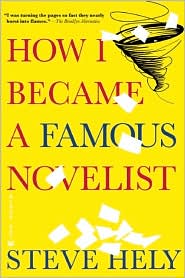
How I Became a Famous Novelist wins Thurber Prize for Humor

One of the funniest books I've ever read, by a writer for the NBC series The Office, has just been awarded the 2010 Thurber Prize for American Humor. Great choice! I wrote a review of this book that was posted elsewhere; with the news of the award I am reposting it below:

Pete Tarslaw, the protagonist of How I Became a Famous Novelist, by Steve Hely, wants to ditch his job fabricating college entry essays for rich applicants. He also wants to upstage his ex-girlfriend at her wedding. In his endeavor to become a novelist, “my ambitions were simple: to learn the con, make money, impress women, and get out.” In writing his completely over-the-top novel, The Tornado Ashes Club, Pete splices together various elements common to literature that appeals to the masses.

The book skewers prototypes of popular authors and the formulas they follow. A fictional New York Times bestseller list is even contained in the book, which ridiculously amplifies popular taste.

How I Became a Famous Novelist is hilarious in a bitingly sarcastic way. In fact, despite quickly laughing my way through it, I sometimes required a break from the constant snarky humor (not a criticism). You need to appreciate the tone to like this book. In its last pages, the book gets earnest all of a sudden. It has, however, provided more than enough entertainment by that point to render it a worthwhile read.

Friday, September 17, 2010

And Then There Were None: four ways

A few weeks ago, I saw a theatrical production of And Then There Were None, adapted from the Agatha Christie novel of the same name (some editions were entitled Ten Little Indians). Did you know that it's the seventh bestselling book ever? And that Christie is the third bestselling author of all time, after the Bible and Shakespeare?

The story involves ten people invited to an island under different pretenses. Once there, each guest is accused by a mysterious voice on a gramophone record of committing a particular murder. Then the guests themselves begin falling prey to a murderer. After each killing, a soldier (or Indian) figurine from the dining room table is broken. In each of their rooms is hung a copy of the nursery rhyme "Ten Little Soldiers" (or "Ten Little Indians") and the murders eerily echo the verses of the rhyme. If they are alone on the island, then the murderer must be among the ten of them, but who?

Christie herself adapted the novel for the stage, changing the ending significantly (basically, injecting a form of a "happy" ending). I was interested in reading the book to compare the two, and my curiosity extended to my viewing two film versions, Rene Clair's And Then There Were None (1945) and George Pollock's Ten Little Indians (1965). In terms of the story, I thought the book was the best, followed by the 1945 film version, the 1965 version, and finally the play. The problem with the play was that it did not spell out certain things that the movie versions did fill in. Ten Little Indians is inferior to the 1945 film for several reasons: the setting is changed to an Austrian mountaintop; some of the characters, their alleged crimes, and how they are killed off are changed (and not for the better); there are too many gratuitous shots of Vera undressing; and it seems too dated to the 60s.

Overall, though, the book cannot be beat. What I most appreciate about it is the "note found in a bottle" postscript. It explains everything from the murderer's point of view. And Then There Were None is an extremely clever mystery!

Friday, September 10, 2010

Paste magazine bites the dust

Last year, amidst financial difficulties, Paste magazine appealed to its readers for donations so that it would not have to cease publication. The readers came through, and the magazine remained in print. Last week, however, Paste announced that its print publication has been suspended: "the prolonged downturn of the ad market has forced a hiatus . . . Paste, while considering strategic alternatives, is focusing on its digital assets, including PasteMagazine.com." That a number of generous readers were able to keep the magazine afloat before makes this news more of a bitter pill.

I had been reading the magazine for a couple of years because I enjoyed its music coverage. I just read a reader comment saying that Paste had gone downhill since it broadened its scope beyond music to include movies and pop culture. I had not been reading it long enough to attest to that, but I wonder how many readers it lost with that change. Paste's announcement is disappointing given the lack of quality and coverage of music magazines currently in print.

Friday, September 3, 2010

At first listen: I'm Having Fun Now

I just received my copy of Jenny and Johnny's album I'm Having Fun Now. This is their debut as Jenny and Johnny, but you might know them for their previous accomplishments as singer-songwriters Jenny Lewis and Johnathan Rice. They have previously collaborated (they are also a real-life couple), but not to the extent that they do here. Johnathan joined Jenny as part of her touring band and they appeared on each other's solo albums. I liked them each separately and collaboratively from what I'd heard so far, so naturally I was eager for this project.

The album has Jenny's trademark deceptively upbeat sound mixed with more downbeat lyrical content written all over it! As in, "I'm having fun now, but I got some cynical banter for you." Johnathan is a talented musician and writer, but Jenny ups him on intrigue and charisma, and he's always been more willing to take a backseat anyway. Still, he rocks out on two of the best tracks: "Animal" and "Committed."

I was hoping for a "that's what I'm talking about" reaction like the one I had to Jenny's "The Next Messiah" on Acid Tongue, which featured Johnathan. They were going for a different sound and idea with this album, and it leaves something to be desired. Though not as complex as I was hoping for, it is called I'm Having Fun Now.