Sunday, February 20, 2011

Reading as an act of "quiet revolution"

In The Lost Art of Reading: Why Books Matter in a Distracted Time, David Ulin expands upon an essay he wrote for the Los Angeles Times in 2009. This slim volume is an ode to the practice of reading in our current age of information overload. Ulin's book combines memoir and literary criticism, a blend that works well. He frames the content with his experience rereading The Great Gatsby as his son reads it for a school assignment.

What reading gives us, Ulin says, is not only meditation apart from other people but also the connection we form with the author through his or her words. "We regain the world by withdrawing from it just a little, by stepping back from the noise, the tumult, to discover our reflections in another mind" (151). Ulin goes so far as to characterize reading in this day and age as revolutionary, "an act of resistance in a landscape of distraction, a matter of engagement in a society that seems to want nothing more than for us to disengage" (150).

The implications of this distracted state are addressed in another recent book, Alone Together: Why We Expect More From Technology and Less From Each Other, by Sherry Turkle, who asserts that we are becoming so "immersed in technology that we ignore what we know about life." This thought is in line with Ulin's belief that we should take a step back from the large number of distractions we face. Few of us are immune, and we all may need reminding about the value of reading.

Thursday, January 6, 2011

Review of Black Swan

Darren Aronofsky has done it again--another harrowing and thought-provoking drama. His previous effort, The Wrestler, has much in common with his latest. Black Swan explores the interplay between madness and art in a competitive context.

Natalie Portman plays Nina Sayers, a ballerina chosen to replace aging Beth (Winona Ryder) as star of the company, playing the lead in Swan Lake. Director Thomas (Vincent Cassel) sees her as a natural White Swan, but she must also play the Black Swan, requiring an abandon he is doubtful that she can possess. Mila Kunis plays Lily, whom Nina sees as her rival but also as someone whose comparative worldliness intrigues her. Barbara Hershey has a memorable turn as Nina's rather suffocating, ex-ballerina mother.

Viewers are made to question how much is reality versus fantasy as Nina's delusions are played out onscreen. I wondered whether or not Lily was completely made up by Nina, given how many of the delusions are wrapped up with her. Some criticism of the film has centered around the horror movie tactics that pick up in the second half of the movie, but that is when Nina's psychological deteroriation increases in severity and therefore make sense. Set against the beauty of the Swan Lake production, Nina's mental breakdown is the more disturbing. For all the figures who are causing her turmoil in her life, Nina is her own worst foe.

The film is not so much about the world of ballet as a broader look at the parallel between art and madness and about delving too far into what one cannot handle. In fact, in a case of life imitating art, the role was nearly too intense for Portman: "There were some nights that I thought I literally was going to die," she said. "It was the first time I understood how you could get so wrapped up in a role that it could sort of take you down." Black Swan is a riveting look at an artist's breakdown, but the message of the movie seems to be a cautionary one rather than a complete romanticization. The violence contained in the film is therefore not gratuitous. The movie may be hard for some to take, but it is well done.

Monday, November 29, 2010

The end-of-year booklists

Every year I am somewhat surprised and dismayed to find that I have read barely any books on the "best of the year" booklists. One reason is that I don't restrict my reading at all to the current year's releases. I also may have different standards than the book reviewers.

Check out some of the lists for 2010:
Kirkus Reviews Top 25 Fiction
Kirkus Reviews Top 25 Nonfiction
Library Journal Top Ten
The New York Times Ten Best Books
The New York Times 100 Notable Books
Publishers Weekly Best Books

What do you think of the selections? Have you read any? I haven't--except for Let's Take the Long Way Home, by Gail Caldwell (a PW pick for best nonfiction).

Notable novels that I want to get around to reading:
Freedom, by Jonathan Franzen
Super Sad True Love Story, by Gary Shteyngart

Notable works of nonfiction that I'm interested in reading:
Autobiography of Mark Twain, Vol. 1, by Mark Twain
Country Driving: A Journey Through China from Farm to Factory, by Peter Hessler
Last Call: The Rise and Fall of Prohibition, by Daniel Okrent

Graphic by Sarah Illenberger for The New York Times

Tuesday, November 2, 2010

Devil in the White City movie in the works!

Leonardo DiCaprio and partners have acquired the screen rights to one of my favorite books, Erik Larson's Devil in the White City. DiCaprio will play serial killer H.H. Holmes, who murdered between 27 and 200 people during the time of the 1893 World's Fair in Chicago.

I am interested in seeing a film adaptation, but have a hard time believing I could like it as much as I like the book. The book is such an intriguing blend of true crime and architectural history. Larson juxtaposes (mostly in alternating chapters) the construction of the World's Fair, a magical success despite many obstacles, with Holmes' sinister construction of the World's Fair Hotel, complete with a gas chamber and crematorium, to which he lured victims. I wonder if World's Fair architect Daniel Burnham, as integral to the book as the notorious serial killer Holmes, will feature as much in the film.

DiCaprio is a good actor, though he looks nothing like the real Holmes, and are audiences interested in seeing him play such a despicable character? If you have read the book, what do you think about it being turned into a movie and about DiCaprio's role in it?

Thursday, October 14, 2010

Book to film: Never Let Me Go

In my blog entry for April 30, I briefly reviewed Kazuo Ishiguro's Never Let Me Go, comparing it to another dystopian novel, The Unit, by Ninni Holmqvist. I recently went to see the movie version of Never Let Me Go (directed by Mark Romanek from a screenplay by Alex Garland). The film adaptation is well done. If you happen to be like me in actually preferring solemn movies that make you think, I recommend this one.

The story centers around the lives of three friends--Kathy, Tommy, and Ruth--played by Carey Mulligan, Andrew Garfield, and Keira Knightley, respectively. All three display good acting. Mulligan is required to convey a lot nonverbally and succeeds. Knightley impresses in completely inhabiting an unsympathetic character. When I read the book, I pictured the character of Tommy as a blond, perpetually youthful pretty boy--not resembling Andrew Garfield--but it is a testament to his acting chops that I was able to accept him in the role.

This is a story of a complicated friendship/love triangle, at first oddly insulated from the cruel reality of the society and then thrust out into it, with the chips falling where they may. Some hope is kept alive, but there is a (perhaps strange) resignation in the attitudes of the friends. Tommy is arguably the most likeable character because he has an innocent, appealing quality and may have the least sense of resignation of the three friends.

The film is largely faithful to the book. In the film version, the shocking premise of the plot is revealed early on by a new teacher, Miss Lucy (Sally Hawkins, in a small but memorable role). In the book, this character does not reveal as much, so the three friends, as well as the reader, are kept in the dark for longer. The book is therefore more subtle. Both the book and the film explore haunting questions about mortality, love, and duty. This is a deeply affecting movie, with an elusive message that is difficult to put into words.

Wednesday, October 6, 2010

October is Vegetarian Awareness Month!

I can't resist plugging Vegetarian Awareness Month, an initiative of the North American Vegetarian Society (NAVS). Non-vegetarians who pledge to go veg for a short duration can enter a random drawing for cash prizes. Vegetarian and vegan diets save animals' lives (over 50 animals a year per person on average), have proven health benefits, and help to preserve the earth. So while to me the #1 reason to adopt a meat-free diet is to not harm animals, these other important reasons also compel people to go vegetarian or vegan. You may have heard former President Bill Clinton talking about his adopting an almost vegan diet (still sometimes eating fish) in a successful effort to lose weight for his daughter Chelsea's recent wedding.

Indeed, vegetarianism continues to permeate our culture. Popular author and food activist Michael Pollan advises, "Eat food. Not too much. Mostly plants." Pollan and Fast Food Nation author Eric Schlosser narrated the recent documentary Food, Inc., examining factory farming and its harmful effects on both animals and the environment. Novelist Jonathan Safran Foer's first foray into nonfiction, Eating Animals, inspired Natalie Portman to go from "a twenty-year vegetarian to a vegan activist."

Here are a few books I recommend on veganism and animal rights:
-Farm Sanctuary / Gene Baur
-The kind diet / Alicia Silverstone
-The pig who sang to the moon / Jeffrey Moussaieff Masson
-Veganomicon : the ultimate vegan cookbook / Isa Chandra Moskowitz

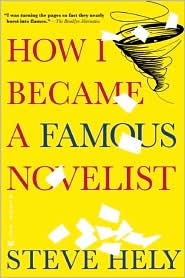
How I Became a Famous Novelist wins Thurber Prize for Humor

One of the funniest books I've ever read, by a writer for the NBC series The Office, has just been awarded the 2010 Thurber Prize for American Humor. Great choice! I wrote a review of this book that was posted elsewhere; with the news of the award I am reposting it below:

Pete Tarslaw, the protagonist of How I Became a Famous Novelist, by Steve Hely, wants to ditch his job fabricating college entry essays for rich applicants. He also wants to upstage his ex-girlfriend at her wedding. In his endeavor to become a novelist, “my ambitions were simple: to learn the con, make money, impress women, and get out.” In writing his completely over-the-top novel, The Tornado Ashes Club, Pete splices together various elements common to literature that appeals to the masses.

The book skewers prototypes of popular authors and the formulas they follow. A fictional New York Times bestseller list is even contained in the book, which ridiculously amplifies popular taste.

How I Became a Famous Novelist is hilarious in a bitingly sarcastic way. In fact, despite quickly laughing my way through it, I sometimes required a break from the constant snarky humor (not a criticism). You need to appreciate the tone to like this book. In its last pages, the book gets earnest all of a sudden. It has, however, provided more than enough entertainment by that point to render it a worthwhile read.